
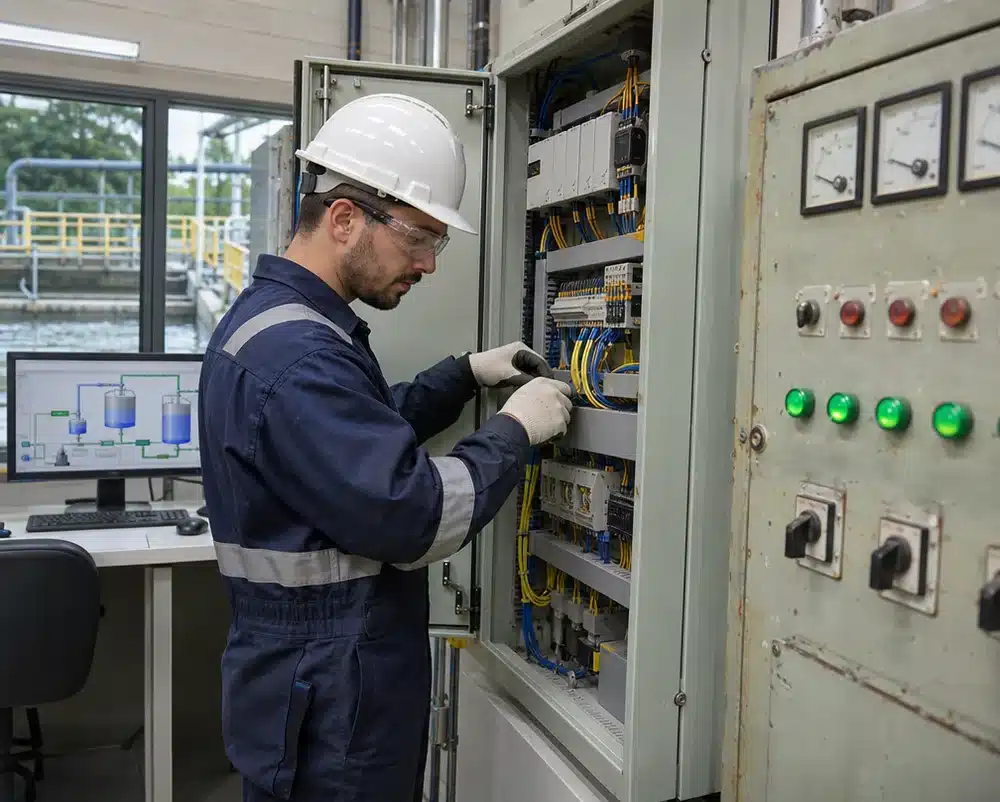
A control system migration on a plant that has to keep running is done in stages, not in one big shutdown. You survey what is really there, replace one area at a time, where possible run old and new together until the new system proves itself, and switch over in planned low-demand windows with a rollback ready.
This guide is for plant, utility and operations managers and project engineers who want a practical plan for a control system migration of PLC, DCS or SCADA controls. It is general information. The design of any specific plant or safety-related system needs qualified engineering for that site.
What does a phased control system migration look like?
In a phased approach, you replace one area, line or unit at a time, with the old and new systems co-existing through gateways. BEC Automation calls it the best balance for most plants. The practical benefit is that production continues from the remaining legacy systems while each phase is completed and validated.
Phasing is not the only option, and the right split depends on your hardware. One manufacturer-specific example: a PLC Exchange migration guide for the Rockwell PLC-5 family describes a remote I/O bridge approach that lets you commission the new processor and converted code against the live, untouched existing I/O, then replace the I/O later as budget allows. It is an example of how a plan can spread risk across several smaller events instead of one large one.
Why survey the existing system first?
Because the drawings rarely tell the whole story. A thorough audit should cover I/O lists, electrical drawings, existing programs, interlocks, network topology and how operators really use the system. Documentation is often out of date, so verify it against the plant itself.
Pay particular attention to hidden logic. The audit should capture workarounds and manual overrides, because the new system must either preserve or consciously replace them. This knowledge is fragile: it lives in the heads of the people who have been doing it for years and does not survive turnover. Ask your longest-serving operators and technicians what they do that is not written down.
A survey verified against the plant is the foundation for every later step in the control system migration. Just as important is the people side: success depends largely on upfront planning and getting buy-in from the operators and other key stakeholders.
How does parallel running work alongside live production?
The new system is first proven without being trusted. In shadow mode you run the new system reading the same inputs and compare its outputs to the old system before it takes control. Where possible, parallel operation of legacy and new systems, comparing outputs, provides the most reliable validation.
Before that, test the converted logic offline. The converted program should be tested in a simulated environment before it goes near production equipment. Shadow mode and parallel running are how a control system migration earns trust before it takes control, and any difference between old and new outputs is a question to answer before cutover, not after.
When should you schedule cutovers in a control system migration?
Schedule the windows first. Shutdown windows are usually the scarcest resource, so schedule them first, then build the project plan backwards from them. For a treatment works, that may mean a period of low flow. For a production plant, it may be a planned outage.
Expect some stop, even if it is short. Often most of the work can be done online, but the final cutover of each section usually needs a short planned stop, and phased migration and parallel running keep those stops short. Treat each cutover as the highest-risk point of the project, one that should be planned with the same rigor as any other critical production event.
What should be ready before each switchover?
Before any section of the control system migration goes live, check that you have:
- Go/no-go criteria that were agreed in advance, with a tested rollback procedure.
- A rollback procedure everyone understands, not just the engineers who wrote it, as the same source advises when it says to prepare a rollback procedure that everyone understands.
- Simulation results for the converted program, as described above.
- Shadow-mode comparison of the new system’s outputs against the old system on the same inputs.
- A well-chosen window: production window selection that minimizes exposure.
- People and parts on hand: engineers and key spares on site during the first days of operation.
Can the migration improve the system, not just replace it?
Yes, within limits. On operator screens, ISA notes that replicating the screens that operators use is usually inefficient and does not improve their situation. Involve operators in what the new screens should show rather than copying the old ones.
On loops, the same article, which discusses a DCS migration, points out that since every loop must be reprogrammed, it is an excellent time to improve their tuning and control conditions. That applies to the DCS migration it describes, and not every migration requires every loop to be reprogrammed. A control system migration is a chance to retire workarounds you found in the survey, as long as each change is agreed, tested and reversible like everything else.
Where does cybersecurity fit in a control system migration?
On the controls side, security should be part of the design from the start, not added afterwards. NIST SP 800-82 Rev. 3, the current final version, gives guidance on how to secure operational technology while addressing its unique performance, reliability and safety requirements. That balance matters in a live plant, where a change that is good for security must still be safe for the process.
How can Santis Engineering help?
Santis Engineering Inc. (SEI) is a controls and automation company in Cape Canaveral, Florida. According to its home page, SEI offers complete engineering, design and build, control panel manufacture, software development, installation, start up, testing and commissioning for new and existing projects and plants, covering controls, electrical, mechanical, hydraulic, pneumatic, networks, SCADA, telemetry and RF/microwave systems. The company says it has been in business for over 25 years and is a member of the Control Systems Integrators Association (CSIA); see the about page. Its listed industries include wastewater treatment, pharmaceuticals, power generation and materials processing, as shown on its about page, and the work page lists project categories such as HVAC, telemetry and hydraulics.
Frequently asked questions
What is a control system migration?
It is the replacement or upgrade of an existing control system, such as PLC, DCS or SCADA controls, with a new one. In a plant that cannot stop, a phased approach can replace one area, line or unit at a time while the remaining legacy systems keep the rest of the plant running.
Can a migration be done with no stop at all?
Often most of the work can be done online, but the final cutover of each section usually needs a short planned stop. Phased migration and parallel running keep those stops short. Plan for them rather than hoping to avoid them.
What is shadow mode?
It is a way of testing the new system against live conditions. The new system reads the same inputs and its outputs are compared to the old system before it takes control. The old system stays in charge of the process during this time.
Why not copy the old operator screens exactly?
ISA’s view is that replicating legacy screens is usually inefficient and does not improve the operators’ situation. Working with operators on what the new screens should show is a better use of the project.
If you are weighing up a staged upgrade for a plant that has to keep running, Get in touch and tell us about your system.
